
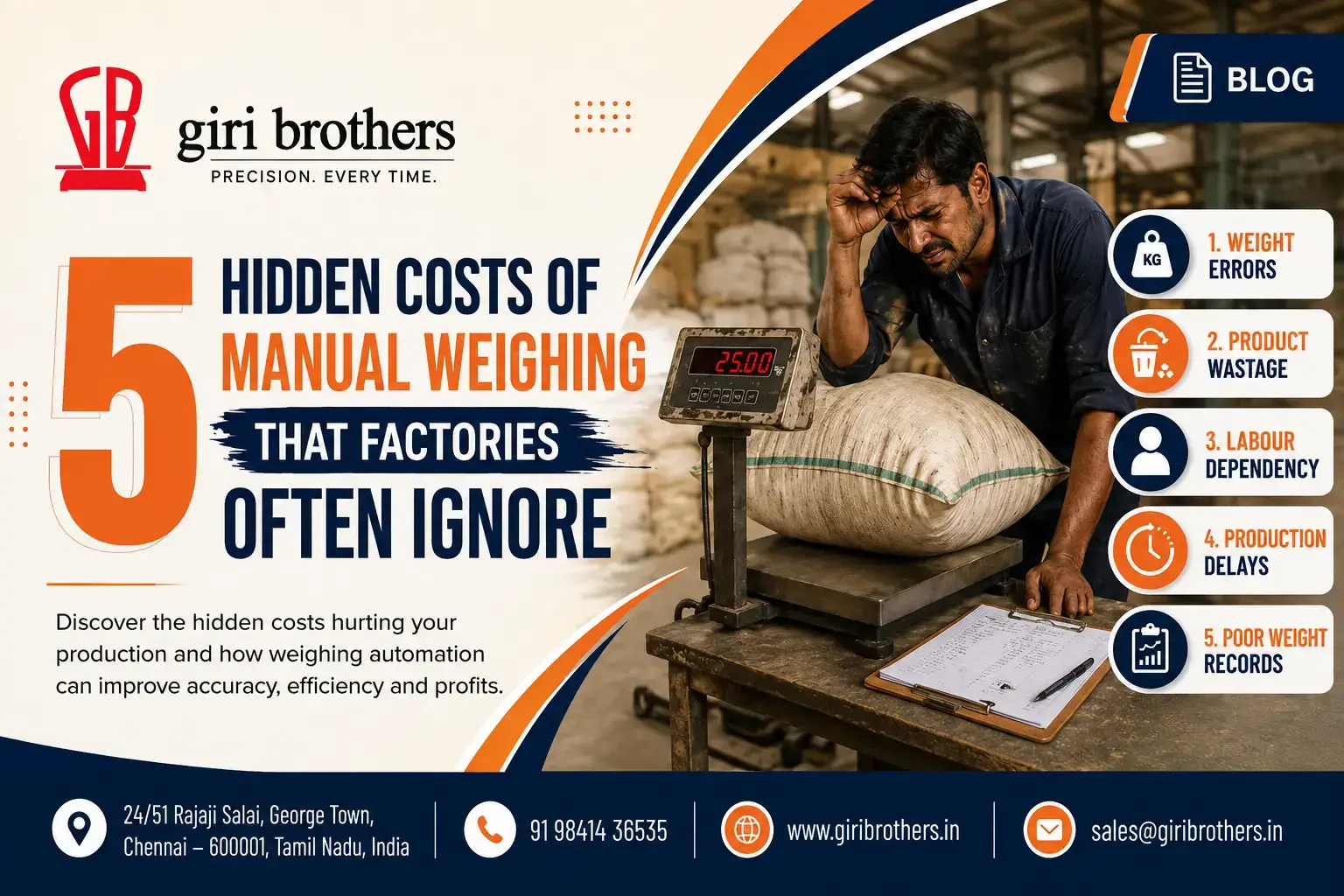
5 Hidden Costs of Manual Weighing That Factories Often Ignore
Manual weighing may look like a simple part of the production process. A worker places a product on a scale, checks the weight, records the result and moves the product to the next stage.But when this happens hundreds or thousands of times every day, small inefficiencies can become significant production costs.Weight errors, product wastage, labour dependency, production delays and inaccurate records can all affect a factory’s efficiency and profitability.This is why more manufacturers are looking at industrial weighing automation to make weighing faster, more accurate and easier to manage.Let’s look at the 5 hidden costs of manual weighing that factories should not ignore.
What Is Manual Weighing?
Manual weighing is a process where an operator is responsible for placing products or materials on a weighing machine, checking the displayed weight, recording the result and moving the product to the next production stage.
For low-volume operations, this may be practical.
However, as production increases, manual weighing can become a bottleneck.
A typical manual process may look like this:
Product → Manual Weighing → Operator Checks Weight → Manual Recording → Filling/Packing → Next Process
With an automated weighing system, the process can become:
Product → Automatic Weighing → Weight Verification → Data Recording → Production Process
The difference may appear small, but across an entire production line, automation can make a significant difference.
1. Hidden Cost of Weight Errors
One of the biggest problems with manual weighing is weight inconsistency.
Even when operators follow the same procedure, human involvement can result in variations in weighing, reading and recording.
For example, imagine a product that should be packed at exactly 25 kg.
If some bags contain slightly more material, the additional material may appear insignificant on one bag.
But consider hundreds or thousands of bags.
Even a small quantity of excess material per bag can become substantial product loss over time.
On the other hand, underweight products can create quality-control problems and customer complaints.
How weighing automation helps
An automatic weighing system can control the weighing process more consistently and reduce dependence on manual weight checking.
Depending on the application, automation can be integrated with:
- Filling systems
- Packing machines
- Bag filling systems
- Conveyors
- Checkweighers
- Production software
- Data recording systems
The goal is simple:
Right weight → Right quantity → Consistent production
2. Hidden Cost of Product Wastage
Manual weighing can also contribute to product wastage.
Consider a filling operation where an operator must manually stop the filling process when the target weight is reached.
Stopping slightly early can result in an underweight package.
Stopping slightly late can result in an overweight package.
The second situation can directly increase material consumption.
This becomes especially important when the product itself has a significant cost.
Small quantity × high production volume = significant loss
For example:
If a production line accidentally gives away just a small amount of additional material in every package, the total loss can increase considerably as daily production increases.
This is why weighing and packing automation can be valuable for high-volume manufacturing.
Automated systems can be designed to control the filling and weighing process according to the required application.
The objective is not simply to weigh faster.
It is to control the quantity more consistently.
3. Hidden Cost of Labour Dependency
Manual weighing requires people to perform repetitive tasks throughout the production shift.
The operator may need to:
- Place the product on the scale.
- Check the displayed weight.
- Record the weight.
- Remove the product.
- Move it to the next process.
- Repeat the same operation.
As production increases, more operators may be required to maintain the same throughput.
This creates a challenge for manufacturers trying to increase production without continuously increasing labour requirements.
Automation changes the workflow
With industrial weighing automation, repetitive weighing and checking operations can be integrated into the production process.
For example:
Conveyor → Weighing → Weight Verification → Sorting/Processing
Instead of making the operator responsible for every individual weighing operation, the weighing system becomes part of the production line.
This can allow operators to focus on higher-value production and quality-control activities.
Automation does not necessarily mean removing people from the process.
Instead, it can mean using people where they add more value.
4. Hidden Cost of Production Delays
A production line is only as efficient as its slowest important process.
If products have to stop for manual weighing, the weighing process can become a bottleneck.
Imagine a production line where products are continuously moving.
If every product must be:
Stopped → Weighed → Recorded → Released
the production flow can slow down.
This is where conveyor weighing systems and online checkweighing become particularly useful.
Weigh Products While They Move
A conveyor weighing system can allow products to be weighed while moving through the production process.
The simplified workflow is:
Product → Conveyor → Online Weighing → Weight Check → Next Process
This approach can reduce the need for separate manual weighing operations.
For high-speed production environments, this can be especially useful where continuous material movement is important.
The key idea is:
Your products keep moving. Your weighing should too.
5. Hidden Cost of Poor Weight Records
Accurate weighing is only part of the process.
Manufacturers also need accurate information about what was weighed.
When weight data is written manually, several problems can occur:
- Incorrect entries
- Missing records
- Duplicate entries
- Difficult-to-read handwriting
- Delayed data entry
- Difficulty tracking production
- Time-consuming reporting
This can make it harder for management to understand what is actually happening on the production floor.
From Weighing to Data
Modern automated weighing systems can be designed to connect weighing information with digital systems.
Depending on the application, weight information can be used for:
- Production records
- Batch records
- Inventory monitoring
- Quality control
- Weight verification
- Reports
- ERP or software integration
This creates a more connected production environment.
Instead of:
Weigh → Write → Enter → Verify
the process can move toward:
Weigh → Capture → Record → Analyse
Manual Weighing vs Weighing Automation
| Factor | Manual Weighing | Weighing Automation |
|---|---|---|
| Weight checking | Operator dependent | System controlled |
| Production speed | Limited by manual handling | Higher automation potential |
| Data recording | Often manual | Can be digitally recorded |
| Product wastage | Higher risk of variation | Better quantity control |
| Labour dependency | Higher | Reduced repetitive work |
| Production flow | Can require stopping | Can support continuous processes |
| Weight verification | Manual | Automatic options available |
| Reporting | Time-consuming | Can be integrated with software |
The right solution depends on the product, production volume, target weight, process requirements and level of automation required.
When Should a Factory Consider Weighing Automation?
Manual weighing may still be suitable for small-scale or low-volume operations.
However, automation should be considered when you experience one or more of these situations:
Your production volume is increasing
As production grows, repetitive manual weighing becomes harder to manage.
Weight accuracy is becoming critical
If even small weight variations affect cost or product quality, automated weighing can help improve consistency.
Labour is becoming a bottleneck
If employees spend a large part of their shift performing repetitive weighing tasks, automation may improve productivity.
Your production line is already automated
If filling, packing and conveying are automated but weighing is still manual, weighing may become the next bottleneck.
You need better production records
If management needs reliable weight information for reporting, inventory or quality control, digital weighing integration can be valuable.
Where Can Industrial Weighing Automation Be Used?
Weighing automation is not limited to one type of industry.
Depending on the application, it can be used in:
- Food processing
- Agriculture
- Chemical industries
- Manufacturing
- Packaging
- Bulk material handling
- Logistics
- Pharmaceutical production
- Industrial processing
- Warehousing
Different applications require different solutions.
For example:
Pouch Products → Packing & Pouching Machines
Bulk Products → Bag Filling & Stitching
Liquids → Liquid Filling Systems
Moving Products → Conveyor Weighing Systems
Tanks, Hoppers & Vessels → Tank Weighing Systems
The best automation solution should be selected according to the actual production process rather than choosing a machine based only on its capacity.
How Giri Brothers Helps Industries Move Toward Automation
Giri Brothers provides weighing and industrial automation solutions designed for different production requirements.
The automation range includes:
- Packing and pouching machines
- Bag filling and stitching systems
- Liquid filling systems
- Conveyor weighing systems
- Tank weighing systems
The objective is to combine accurate weighing with efficient production processes.
For manufacturers, this can mean moving from isolated manual weighing operations toward a more connected and automated workflow.
The Future of Factory Weighing Is Automation
Manual weighing may appear inexpensive because the equipment itself can be simple.
But the real cost can be hidden inside:
Weight errors + Product wastage + Labour dependency + Production delays + Poor records
As production volumes increase, these costs can become more significant.
Industrial weighing automation provides manufacturers with an opportunity to improve the way products are weighed, filled, checked, recorded and moved through the production line.
The future is not simply about having a better weighing machine.
It is about making weighing part of the automation process.
Ready to Automate Your Weighing Process?
If your factory is still relying heavily on manual weighing, it may be time to evaluate where automation can improve your production process.
From packing and pouching to bag filling, liquid filling, conveyor weighing and tank weighing, the right automation solution can be designed around your production requirements.
Talk to Giri Brothers about your industrial weighing and automation requirement and find the right solution for your production line.